
The Vibe Coding Wall
Every ambitious vibe-coded software project eventually reaches the same inflection point.
You built the MVP in three weeks using AI tools. You have fifty active beta users, and paying customers are starting to sign up. But now, you need things that generic prompting cannot easily solve:
- Handling high-concurrency Stripe webhook race conditions where users double-click checkout.
- Enforcing strict multi-tenant data isolation for an enterprise client security audit.
- Optimizing database queries that are timing out under real user load.
- Connecting complex bi-directional WebSocket feeds with offline synchronization.
You realize you need a professional software engineer—either a technical co-founder, a senior contractor, or an agency.
You send them your GitHub repository. Two days later, you receive their response:
"This code is a black box of AI-generated spaghetti. There are duplicate abstractions, missing environment variables, zero integration tests, and half the database types are hallucinated. We cannot work with this. We will have to rewrite the application from scratch for $30,000."
This is the vibe coding handoff trap. It is the heartbreaking moment when a founder realizes their rapid progress might be discarded.
The good news? You do not have to rewrite your app. If you prepare your codebase properly before approaching developers, engineers will gladly build on top of your prototype.
Why Developers Hate Unaudited AI Codebases
To understand how to prepare a great handoff, you must understand what terrifying problems engineers see when they clone an unprepared vibe-coded repository:
1. The Mystery Environment Setup
The developer runs git clone, runs npm install, and then hits an immediate wall. There is no .env.example file. Half the API keys have unknown permissions, and the local seed script crashes because the database schema requires mysterious rows that only exist on the founder's personal laptop.
2. Illusion of Architecture
To a non-technical founder, if the screen displays a button and clicks navigate to another page, the app "works." To an engineer, five different patterns for state management, conflicting database connections, and silent error catch blocks (catch (e) { /* ignore */ }) signal that the app could collapse under any unexpected edge case.
3. Lack of Verified Business Rules
When a developer asks: "Can a workspace owner delete their own account while an active subscription exists?", the founder often replies: "I think the AI handled that." If the business logic only exists inside a 40-prompt chat history that the engineer cannot see, the engineer cannot safely modify code without breaking unwritten rules.
| What Founders Hand Over (Triggers a Rewrite) | What Engineers Need (Enables Immediate Work) |
|---|---|
A messy repository with 15 untracked .env values. | A verified .env.example with clear dummy credentials. |
| Zero automated tests or reproduction scripts. | A single end-to-end smoke test covering the core user journey. |
| Narrative explanations of how the app is supposed to work. | A 2-page architecture summary of schemas, APIs, and invariants. |
| Uncleaned prototype experiments left in the tree. | Dead files, unused packages, and commented-out code deleted. |
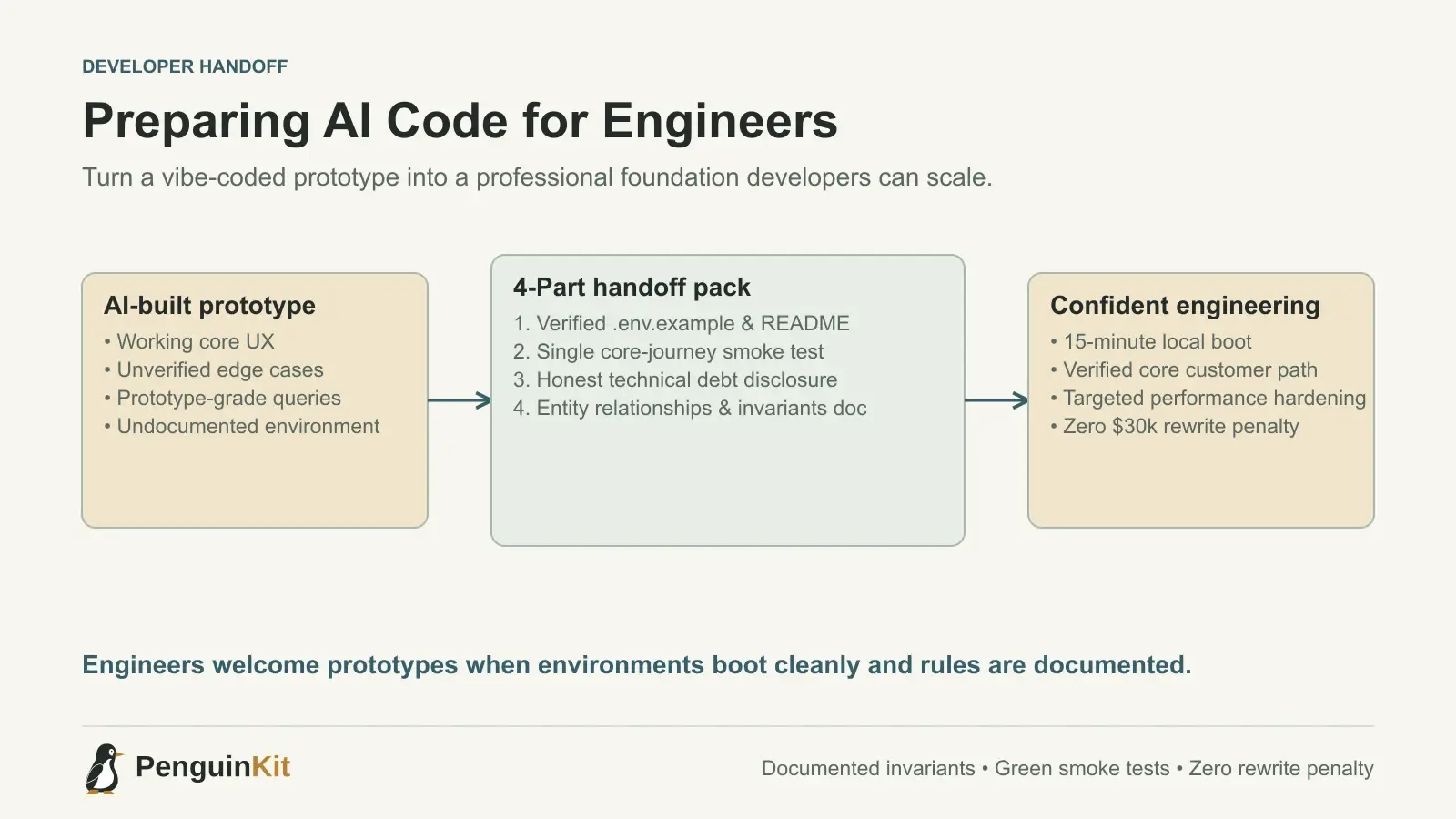
The 4-Part Handoff Preparation Kit
Before you share your repository with an external developer or agency, spend one afternoon running through this four-part handoff preparation protocol.
1. Create a Bulletproof README.md and .env.example
A developer should be able to clone your repository and see the application running locally in less than fifteen minutes without asking you a single question.
Provide a clean .env.example containing every required key with descriptions:
# Database (PostgreSQL / Supabase)
DATABASE_URL="postgresql://postgres:postgres@localhost:5432/myapp_local"

# Authentication
NEXT_PUBLIC_SUPABASE_URL="https://example.supabase.co"
NEXT_PUBLIC_SUPABASE_ANON_KEY="eyJhbGciOi..."
SUPABASE_SERVICE_ROLE_KEY="eyJhbGciOi..."

# Payments (Stripe Test Mode)
STRIPE_SECRET_KEY="sk_test_..."
STRIPE_WEBHOOK_SECRET="whsec_..."
In your README.md, document the exact three commands needed to start from scratch:
## Local Setup
1. `npm install`
2. `cp .env.example .env.local`
3. `npm run db:setup` (runs migrations and seeds test data)
4. `npm run dev`
2. Provide a Single Core-Journey Smoke Test
Engineers do not expect 100% test coverage on an early-stage startup codebase. But they must know when their changes break your primary user flow.
Write one simple integration test or automated script that exercises the core business journey:
- Create a test user account.
- Complete one core transaction (e.g., creating a project or generating an invoice).
- Query the database to verify the record was created with the correct status.
When an engineer can run npm test and see a green checkmark, their confidence in your codebase skyrockets.
3. Document the "Known Technical Debt" Honestly
Developers respect founders who are honest about prototype limitations. Nothing builds trust faster than a frank technical debt summary in your repository.
Create a document called docs/TECHNICAL_DEBT.md that lists:
- What is solid: "The front-end design, UI component library, and Supabase auth flow are tested and working."
- What is prototype-grade: "The Stripe webhook handler currently lacks idempotency protection; duplicate events can cause duplicate credit allocations."
- What is known to be broken: "Database queries in
app/api/reports/have no pagination and will slow down when user records exceed 1,000 rows."
By explicitly pointing out the rough edges, you save the developer hours of forensic archaeology and prove that you understand your product's maturity.
4. Provide an Architecture and Invariants Map
Do not force an engineer to decipher business rules from React components. Write a concise, 2-page architecture summary covering:
- Entities & Relationships: The 4-5 primary database tables and how they link together.
- System Invariants: The absolute rules of the business (e.g., "Projects can only have one active subscription at a time; admins cannot delete projects that have unprocessed financial transactions.")
- Third-Party Dependencies: What external APIs are used (e.g., Resend for emails, OpenAI for text generation, Stripe for billing).
Turn AI Speed into Long-Term Engineering Value
Vibe coding is the fastest way in human history to discover product-market fit and validate customer demand. But code that cannot be extended by human engineers is an expensive disposable prototype.
By structuring your repository, verifying environment setups, and documenting your system invariants, you ensure that your AI-built software serves as the permanent launchpad for your company's growth.
To learn more about bridging the gap between AI generation and professional software engineering, explore our guide on how to hand off a project plan to an AI coding tool and how to test your first AI-built milestone. If you want an authoritative development kit that includes data models, security boundaries, and verified handoff criteria, start with PenguinKit.
Give your idea a clear starting point.
Bring an idea or an existing brief. PenguinKit helps you shape a project foundation you can review, refine and build from.
Start your project