
The Marathon Prompting Mirage
It is easy to lose track of time when vibe coding. You sit down with a fresh chat thread in Cursor or Claude Code at 10:00 AM, intending to build an invoice management feature.
For the first ninety minutes, the AI is brilliant. It creates the database models, sets up PDF generation, and styles an elegant invoice preview modal. Emboldened by how fast things are moving, you keep going. You ask it to add Stripe payment links, automated email receipts, multi-currency support, tax calculation rules, and client discount codes—all within the exact same chat thread.
By 3:00 PM, subtle degradation sets in.
The model starts hallucinating non-existent database columns. It forgets that you are using Tailwind instead of CSS Modules. It strips out the authentication check you added three hours earlier, leaving the invoice download endpoint accessible to anyone on the internet. When you ask it to fix a simple button alignment, it rewrites the entire PDF generation pipeline and breaks the build.
What happened? You fell victim to context amnesia.
How Context Amnesia Destroys AI Quality
Large language models have finite context windows. While modern tools boast context windows of 128k or 200k tokens, the effective reasoning capacity of a model degrades significantly as the window fills up.
1. Attention Dilution (The "Lost in the Middle" Effect)
When a prompt thread reaches dozens of turns, the model's attention mechanism must weigh thousands of tokens of chat history, terminal outputs, and intermediate file edits. Crucial system rules defined at the start of the chat get diluted by the sheer volume of subsequent noise.
2. Conversational Hallucination Reinforcement
If an AI suggested a suboptimal pattern at prompt number 12, that pattern is now permanently part of its context history. By prompt 35, the model treats its own earlier workaround as an established project standard, compounding errors with every subsequent response.
3. Drift from Original Scope
Without rigid milestone boundaries, feature requests expand organically. What began as "view an invoice" drifts into "build a complete accounting suite." As scope expands, the AI makes silent trade-offs, dropping security boundaries, error handling, and accessibility to squeeze the generated code into token generation limits.
| Marathon Chatting (High Risk) | Structured Vibe Sprints (High Quality) |
|---|---|
| Single chat thread spanning 6+ hours and 50+ prompts. | Scoped 45-to-60 minute sprints with fresh context windows. |
| Vague, open-ended goals ("let's add billing"). | Precise micro-spec with defined inputs, outputs, and invariants. |
| Modifying 15 files across multiple domains simultaneously. | Single feature branch touching only 2-3 tightly scoped files. |
| Relying on manual clicking to verify work. | Automated acceptance test validating the feature before merge. |
The 3-Step Vibe Coding Sprint Methodology
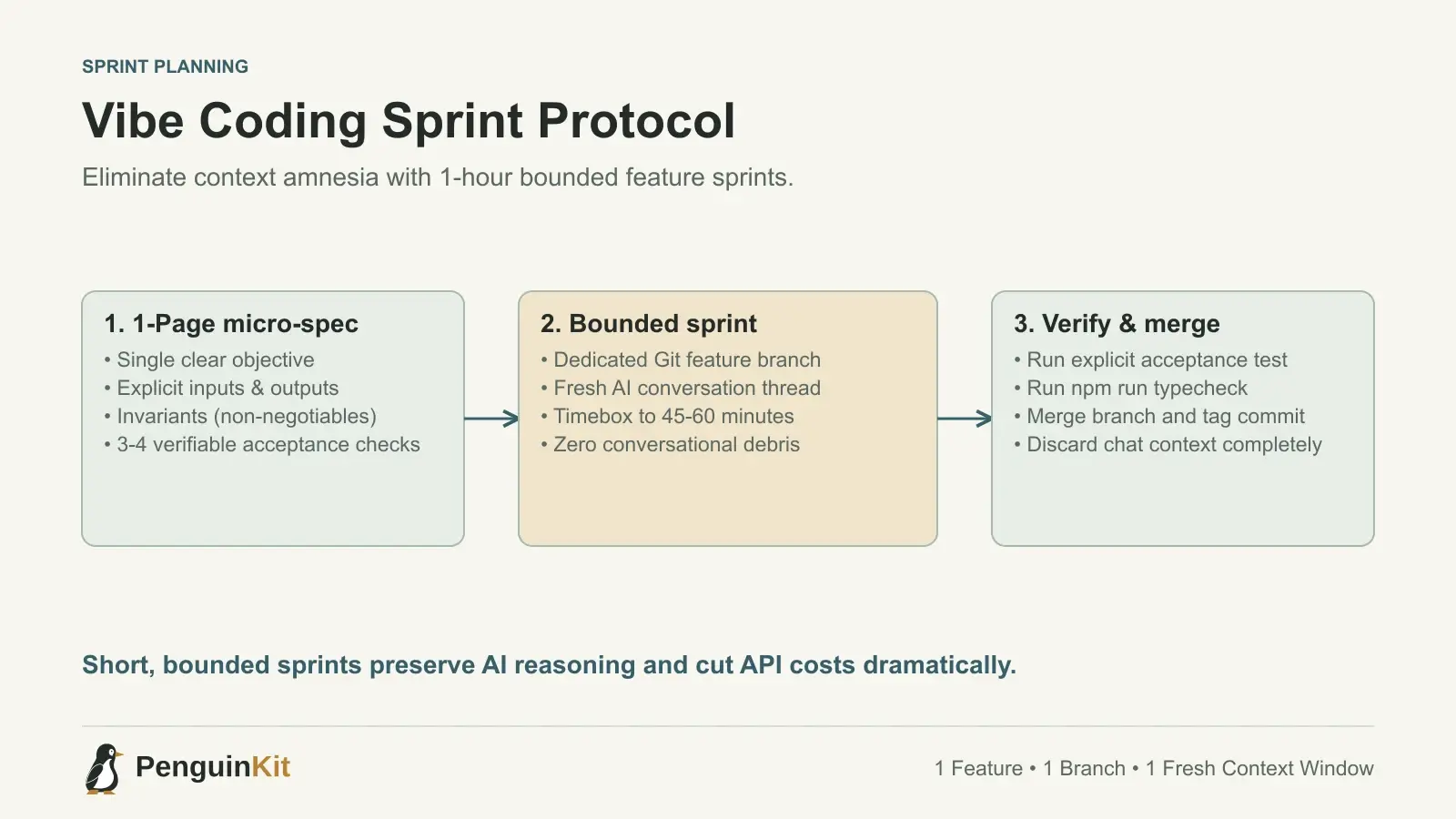
To maintain peak AI reasoning and eliminate context drift, structure your building sessions into modular Vibe Coding Sprints.
Step 1: Write a 1-Page Micro-Spec Before Opening the Editor
Never prompt an AI with a raw, unstructured thought. Take five minutes to write a compact markdown micro-spec that outlines four critical dimensions:
- The Objective: What single user capability are we adding?
- Inputs & Outputs: What parameters enter the system, and what data leaves?
- Invariants (Non-Negotiables): What rules must NEVER be broken? (e.g., "Users can only see invoices belonging to their workspace; public unauthenticated downloads are strictly prohibited.")
- Acceptance Criteria: What 3-4 specific checks prove the feature works?
# Sprint Spec: PDF Invoice Download

## Goal
Allow authenticated workspace members to download a PDF of a paid invoice.

## Invariants
- Enforce workspace role check (`requireWorkspaceMember(invoice.workspaceId)`).
- Return HTTP 403 if the user belongs to a different workspace.
- Do not store generated PDFs on disk; stream directly to the response.

## Acceptance Checks
1. Clicking "Download PDF" streams a valid `application/pdf` buffer.
2. Unauthenticated requests return 401.
3. Accessing another workspace's invoice returns 403.
Step 2: The "1 Feature, 1 Branch, 1 Fresh Context" Rule
Every sprint must be completely self-contained:
- Create a dedicated Git branch:
git checkout -b feature/invoice-pdf-download - Open a fresh AI conversation: Clear the chat or restart the agent session. Provide your micro-spec and only the relevant files needed for this task.
- Execute the sprint: Let the AI write the code, run typechecks, and verify the acceptance criteria.
- Timebox to 60 minutes: If the feature is not completed within an hour, pause. Either the scope was too broad, or the underlying architecture has unresolved ambiguity.
Step 3: Verify the Acceptance Criteria and Merge
Before merging your feature branch back into main, verify the acceptance criteria you defined in Step 1.
Do not accept generic promises from the AI like "I have implemented the security check." Test it with a real request:
# Verify the 403 boundary
curl -i http://localhost:3000/api/invoices/inv_foreign/pdf \
  -H "Authorization: Bearer $TEST_USER_TOKEN"
Once the checks pass, run a typecheck and merge:
npm run typecheck
git add -A
git commit -m "feat: authenticated invoice pdf download stream"
git checkout main
git merge feature/invoice-pdf-download
Discard the chat context completely. When you start your next sprint, open a brand-new conversation. Your AI assistant will begin with maximum cognitive capacity, unburdened by earlier conversational debris.
Why Sprints Reduce Vibe Coding Costs
Structuring your work into modular sprints does not just protect your codebase—it dramatically reduces your API consumption and subscription costs.
When you send a prompt in a thread with 50 previous messages, the model processes the entire 80,000-token conversation history on every single turn. You burn through tokens twenty times faster than starting in a clean 2,000-token context.
By keeping your sessions focused, short, and bounded by clear specifications, you build faster, spend less, and produce software that stays reliable over time.
To explore cost management techniques in detail, read how to reduce vibe coding costs without losing progress and our comprehensive guide on how to define MVP scope before building with AI. If you want an expert, pre-structured roadmap of development sprints tailored to your project idea, plan your build with PenguinKit.
Give your idea a clear starting point.
Bring an idea or an existing brief. PenguinKit helps you shape a project foundation you can review, refine and build from.
Start your project