
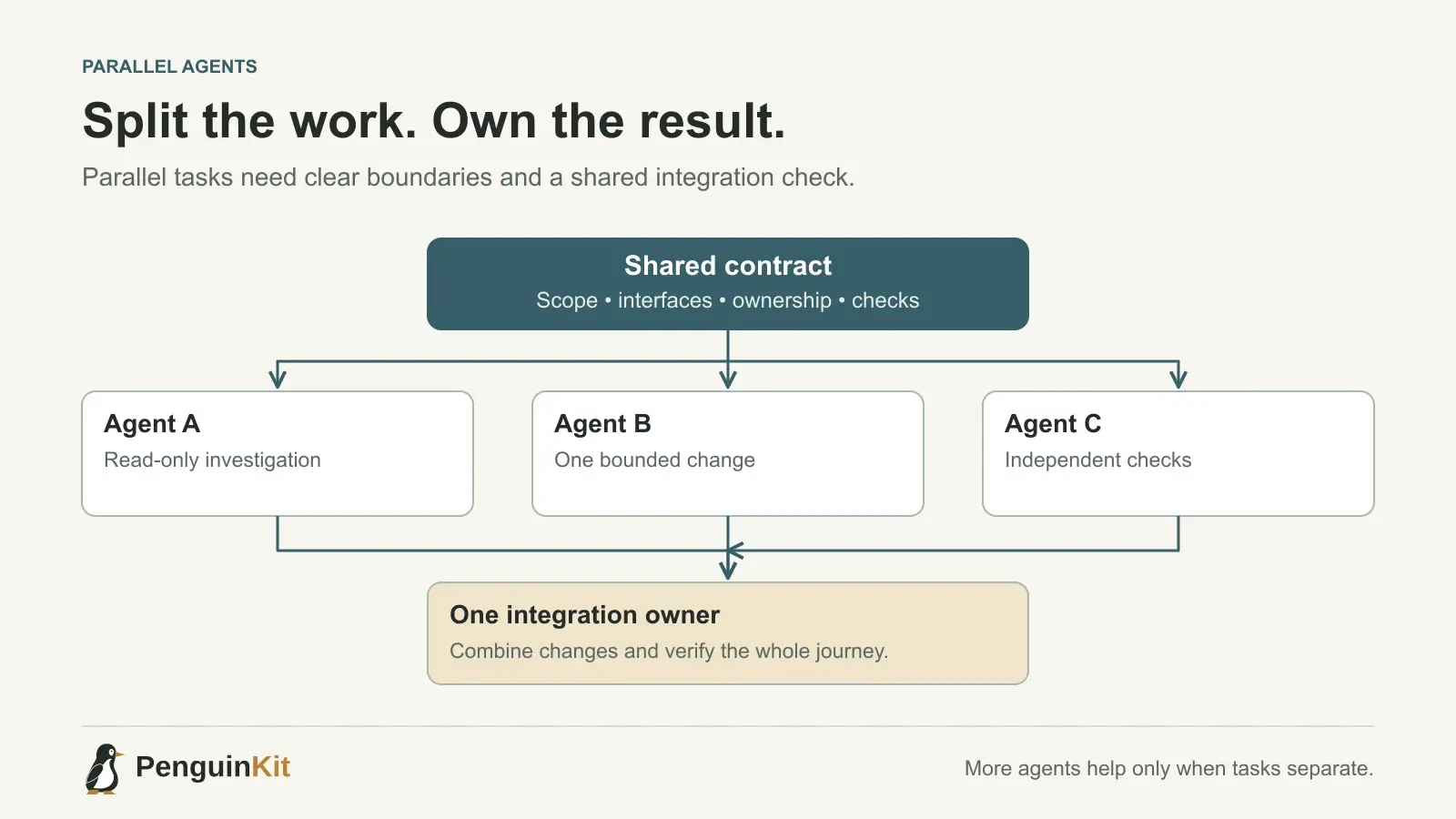
One coding agent is working on your app. A second could write tests, a third could polish the interface and a fourth could tackle the database. It sounds like a straightforward way to finish sooner—until two agents change the same contract and a passing feature stops working when their changes meet.
Parallel AI coding is useful when work can be separated and checked. It is less useful when several agents are still discovering what the product should do. Before adding agents, define the shared decisions, ownership boundaries and integration checks.
What has changed about parallel coding?
Coding tools increasingly support workflows in which several agents investigate or implement tasks at the same time. Anthropic's compiler experiment is a concrete example of both the potential and the coordination challenges. It describes a substantial research effort, not a promise that every small application benefits from an agent team.
The lesson for an early-stage founder is to separate genuinely independent work. Agent count is not a completion metric. A useful metric is how much checked work reaches the application without creating conflicting decisions or extra repair effort.
Use one agent while the foundation is unsettled
If you are still deciding whether your idea is a local script, an automation or a hosted product, several implementers can multiply assumptions. One may add accounts while another builds a file-based tool. Each can produce plausible work that does not fit the same product.
Start by agreeing the useful first journey, where it runs, what data it needs and the important technical choices. Those decisions do not need to cover every future feature. They need to make the current milestone coherent.
For example, a small enquiry tracker might have one agreed milestone: an authenticated user can create an enquiry, view it later and update its status. The storage model, ownership rule and API response shape affect several parts of that journey and should have a clear owner.
Distinguish investigation from concurrent editing
Parallel investigation can be helpful before parallel implementation is safe. One agent can read the current data flow while another reviews relevant tests, provided neither changes shared files. Their findings still need reconciliation against the same code version.
Concurrent edits require stronger boundaries. Separate branches or worktrees can keep edits apart while they are being made, but they do not resolve incompatible architecture or business rules. Someone must own the shared contract and the final merge.
Use parallelism for an independent documentation pass or a separate, well-defined component. Keep tightly coupled changes—such as a schema change and the code that depends on it—in an explicitly coordinated sequence.
Give every task an owner and a completion check
Replace “build the frontend” with a bounded task. A useful task states the files or module it owns, the interface it consumes, what it must preserve and the evidence required to call it complete.
For the enquiry tracker, you could divide the work like this after agreeing the contract:
| Task | Boundary | Completion evidence |
|---|---|---|
| Enquiry list interface | Uses the agreed API; no schema edits | Loading, empty and populated states checked |
| Independent API tests | Tests the agreed ownership and validation rules | Expected success and denial cases demonstrated |
| Getting-started guide | Uses verified commands; no app changes | A fresh setup follows the documented steps |
The task that changes the shared data model should not be silently duplicated. If a task discovers a necessary contract change, it reports the dependency before other agents continue against an obsolete assumption.
Write a task contract the agent can follow
Here is a fictional instruction for the list interface:
Implement the enquiry list using the agreed response documented in
docs/enquiry-api.md. Inspect the existing UI patterns first. Own only the list
component and its relevant presentation checks. Do not change authentication,
the database schema or API response fields. If the contract is insufficient,
report the specific issue before changing it. Return changed files, checks
performed and any unresolved dependency.
Adapt the paths to the real workspace. The value is explicit ownership, not the particular filename. For durable repository guidance, see AGENTS.md, CLAUDE.md and Cursor rules.
Integrate in small steps
Choose one integration owner. Bring in a completed task, inspect the diff, run its relevant checks and verify the connected user journey before merging another tightly related change. A passing test in an isolated branch does not establish that the combined application works.
If two agents both modify a dependency file, resolve the intended dependencies rather than selecting whichever text happens to merge. If one task changes an endpoint, update and verify its consumers together. Keep a working checkpoint so a failed integration does not erase unrelated progress.
The shared progress note should say which work is integrated, which is awaiting review and which is blocked by another task. “Agent finished” and “feature verified in the application” are separate states.
Measure the coordination cost
Try a small comparison before scaling the team. Track elapsed time, agent usage, time spent reviewing changes and time spent repairing integration defects. Parallel work that finishes quickly but creates an afternoon of reconciliation may be a poor trade for your project.
Add another agent when there is an independent queue of work and enough review capacity. Reduce concurrency when tasks repeatedly collide, assumptions diverge or the integrator becomes the bottleneck. There is no universal ideal agent count.
For a small script, one agent and a clear check may be entirely sufficient. A larger product may benefit from separate implementation, testing and documentation tasks once the interfaces are stable.
Plan the work before multiplying it
PenguinKit helps organise the project foundation, major decisions and practical build steps. Use that foundation to define tasks your coding tools can actually own, then compare it with the current implementation as the project evolves.
Start your project foundation, or use our guide to testing your first AI-built milestone. Parallelism is an option for delivering a clear plan, not a replacement for having one.
Give your idea a clear starting point.
Bring an idea or an existing brief. PenguinKit helps you shape a project foundation you can review, refine and build from.
Start your project