
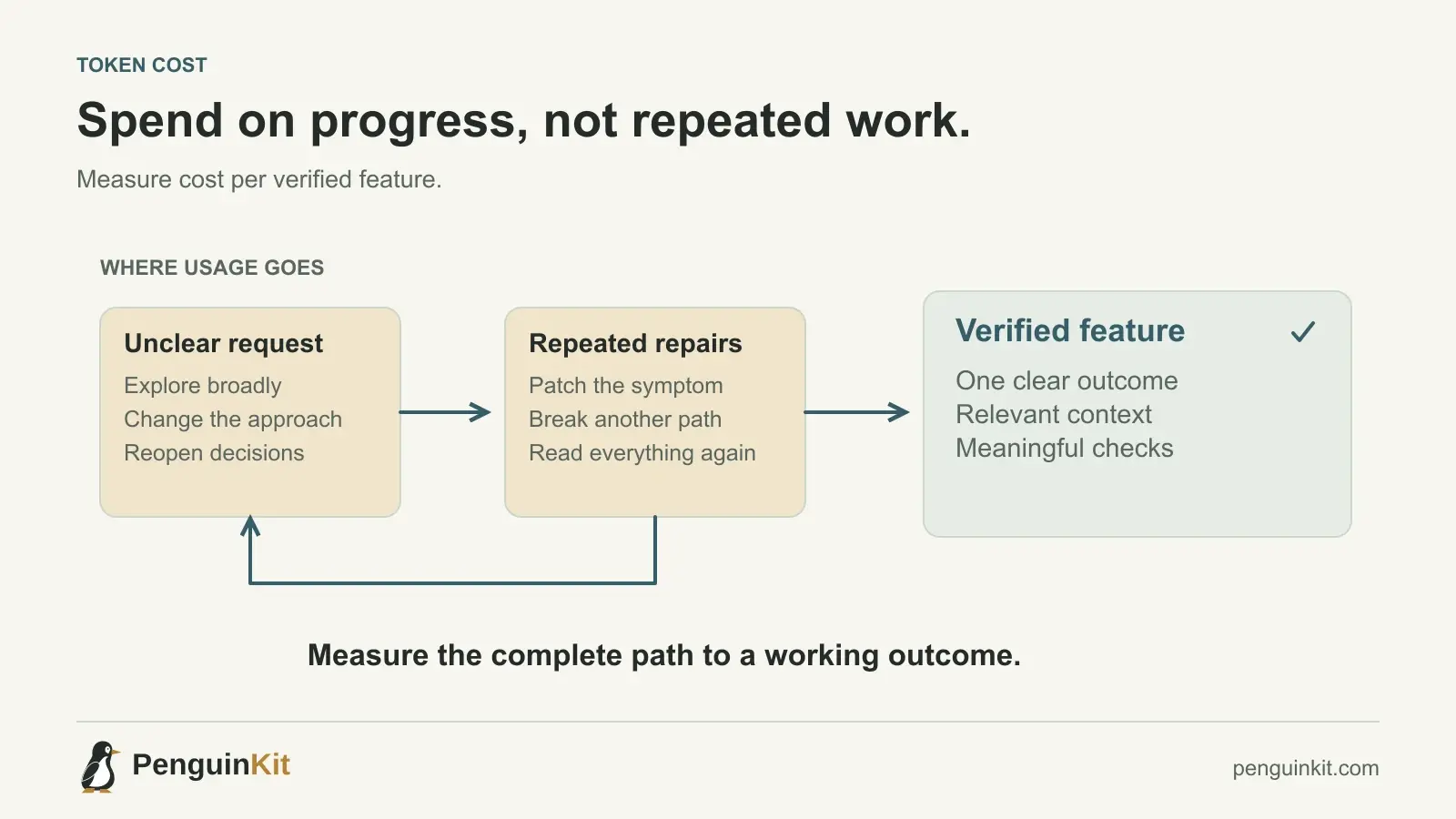
Reducing vibe coding token cost starts with measuring the work that actually ships. A short prompt can trigger an expensive investigation, while a longer, well-scoped request can produce a useful change in one pass. The practical goal is to spend less on each verified feature, including the investigation, fixes and checks needed to finish it.
If your AI coding bill keeps growing but the app feels unfinished, start with one feature. Define its outcome, give the agent relevant context, record the usage and check whether the behavior works. That gives you something more useful than a raw message count: a way to see where effort is being wasted.
Why a cheap prompt can become an expensive feature
Consider a request to add team invitations. The first instruction sounds simple: “Let me invite a teammate.” But the agent still needs to discover who can invite people, which organization owns the invitation, what permissions the recipient receives and how acceptance works.
If those decisions emerge across unrelated edits, the agent may repeatedly change the same screens, routes and database records. The visible feature stays small while the amount of rework grows.
This is a planning problem as much as a model-pricing problem. Lower-cost generation does not help much if you repeatedly rebuild the wrong behavior.
Anthropic’s cost-management documentation explains that context size affects token usage and that caching can reduce charges for repeated content. Check your tool’s current usage reporting rather than treating every token as equally priced.
Measure cost per verified feature
For API-billed work, use a simple calculation:
Cost per verified feature =
  total attributable AI charges / features meeting their agreed checks
For subscription tools, track the reported allowance or credits consumed, alongside elapsed time. Those figures are useful within that product, but they are not interchangeable with another provider’s token bill.
Your record can be a note with five fields:
- The behavior being added or repaired.
- The agreed checks that define completion.
- The reported usage or attributable charge.
- The number of attempts that changed code.
- The final outcome: verified, blocked or abandoned.
Suppose a feature consumes $3 in the first attempt and $2 in corrections. Its attributable cost is $5, not $3. These numbers show the calculation; they are not provider rates or a claimed PenguinKit result. If a cheaper model needs repeated repairs, compare the total outcome before deciding it saved money.
Read the token breakdown without double-counting
Separate input, cached input and output in the usage view your provider supplies. If a provider reports cached tokens as part of total input, do not add those cached tokens to the input total a second time. Likewise, do not add a reasoning-token subtotal to output when the provider already includes it there.
Use the documented units and rates for the actual provider. Cache writes, cache reads, ordinary input, generated output and tool calls may have different pricing rules. A tool’s displayed cost may be an estimate rather than the authoritative invoice.
For a simple API arrangement with one input rate and one output rate, the calculation is:
Token charge =
  input tokens × input rate per million / 1,000,000
  + output tokens × output rate per million / 1,000,000
Where caching or additional tools have separate rates, use the applicable documented categories instead. Do not insert a cached rate into this simple formula while also charging those same tokens as ordinary input. Check your result against the provider’s usage ledger.
Token counts explain resource use. Charges explain the bill. Track both when available, because a lower token count does not necessarily mean a lower charge across different models.
Keep a feature ledger with a clear boundary
Give the feature a short identifier before work begins. Record all attributable investigation, implementation and correction calls until its agreed checks pass. If a shared architecture investigation supports several features, record it as shared work rather than claiming it belongs to each feature in full.
A spreadsheet or CSV can start with these columns:
feature_id,tool,model,attempt,stage,input_tokens,cached_input_tokens,
output_tokens,reported_cost,currency,check_result,notes
Leave unavailable values empty rather than converting them to zero. In the notes, distinguish estimated charges from invoice figures. Keep private prompts, credentials and customer records out of the ledger; an identifier and short activity summary are enough for this purpose.
At the end, calculate total attributable cost, how much went into repair and whether the original behavior was delivered. This exposes a feature that appears cheap only because unfinished work has been left outside the measurement.
Give each implementation request a finish line
A useful request names the behavior, the affected boundary and the evidence of success. For the invitation feature, that could be:
Implement invitations for the existing team workspace.
Reuse the current authentication and email systems.

Only an administrator may invite someone to their own workspace.
An invitation must not grant access before the recipient accepts it.
Do not add billing changes or redesign the member list.

Inspect the current implementation first. Implement the smallest
complete slice, then check authorization, acceptance and replay.
Report what ran, what passed and what remains unverified.
This leaves implementation room without asking the agent to guess the access boundary. See our guide to prompts for app features for a reusable request structure.
Keep durable context small and useful
Save stable decisions in project files: the goal, important boundaries, chosen tools and the next milestone. Do not paste the full history of every failed attempt into every new task.
When you begin a fresh conversation, provide a focused handoff:
- What the app should do.
- What already exists and where to inspect it.
- Which decisions must remain unchanged.
- The current failure or next feature.
- The checks needed to finish this task.
Do not remove relevant constraints merely to shrink the prompt. An omitted ownership rule can cost much more in correction work than a few extra lines of useful context. Our context-management guide covers the difference between durable project knowledge and temporary conversation detail.
Compare two approaches on the same task
Start each comparison from the same recoverable code version, with the same requirement, relevant context and acceptance checks. Record the model, settings and tool configuration. Otherwise you may be comparing different work rather than different approaches.
Run more than one representative task before drawing a broad conclusion. A simple layout change does not establish the cheapest way to repair an authorization defect. Count unsuccessful attempts and unfinished runs as part of the observation; do not quietly remove them from the cost record.
Prefer a practical decision such as “this option is adequate for these routine tasks” over an unsupported claim that one model is always cheaper. For broader budgeting, keep hosting and the finished app’s AI usage separate from the cost of building it; see our MVP budgeting guide.
Match model capability to the consequence of the task
A routine label change and a payment-state correction do not need the same investigation. Use a model that can handle the reasoning required by the task, and verify the result independently of how confident the response sounds.
Current Cursor guidance distinguishes faster models for routine edits from more capable models for complex reasoning. Your own results should decide whether a cheaper option is adequate for a particular workflow.
Avoid splitting a tightly connected change among several agents merely to make it look faster. Coordination, duplicated reading and conflicting patches can consume the savings. Parallel work is useful when responsibilities are genuinely separable and the integration check is clear.
Stop rework without weakening verification
The wrong economy is asking the agent to skip tests so the feature appears finished sooner. A better economy is running the smallest meaningful checks during development and the relevant broader checks before release.
Keep the output concise, but retain the actual result. “The invitation test passed” should identify the command and outcome. A proposed test is a next action, not evidence that the behavior works.
If the same symptom survives successive patches, ask for an updated diagnosis before another edit. A useful pause identifies what the last attempt ruled out and what evidence the next attempt will gather.
Where PenguinKit fits
PenguinKit helps you turn an idea or brief into a reviewed project foundation: scope, consequential decisions, an appropriate technical approach and practical build steps. You can supply the relevant documents to your chosen coding tool rather than reconstructing the project’s direction in every session.
That planning step can help reduce avoidable rework, but savings depend on the implementation and how you use the documents. Measure your own cost per verified feature. Start with one bounded outcome, build it, check it and carry the useful context forward.
Common questions
Does a shorter prompt always use fewer tokens overall?
No. Total usage includes the context processed, generated output and any additional investigation or repair turns. A concise but incomplete instruction can create more work than a clear request with the necessary constraints.
Should I always use the cheapest coding model?
Choose based on the complete task. A cheaper model can be suitable for routine changes; a consequential design or difficult defect may justify greater reasoning capacity. Compare verified outcomes and total usage.
Can planning guarantee lower AI costs?
No fixed saving applies to every project. Planning makes scope and decisions easier to preserve. The measurable benefit is whether your actual work needs fewer avoidable corrections.
Give your idea a clear starting point.
Bring an idea or an existing brief. PenguinKit helps you shape a project foundation you can review, refine and build from.
Start your project